
Advisory Council on Climate Change Adaptation (ACCCA)
The Advisory Council on Climate Change Adaptation (ACCCA) is intentionally composed as a balanced and interdependent body, where different types of members contribute complementary forms of expertise. Rather than operating as a purely scientific panel or a policy forum, the Council brings together a layered structure of actors whose roles intersect across research, governance, and implementation.
At the foundation of the ACCCA are the scientific research leaders, primarily drawn from Romania’s national research and development institutes. These members—senior researchers and institute directors—provide the analytical core of the Council. Their work is grounded in long-term observation, data collection, and advanced modeling of marine and freshwater systems. Through their expertise in Black Sea dynamics, Danube Delta processes, and climate-related environmental change, they anchor the Council’s work in robust scientific evidence. Their primary contribution is to define the key knowledge gaps, validate emerging findings, and ensure that all strategic directions remain scientifically credible.
Closely interconnected with this group are the academic experts, who expand the Council’s capacity for interdisciplinary thinking. Coming from major universities, these members bring a broader conceptual and methodological perspective, linking engineering, environmental sciences, biology, and maritime studies. Their presence ensures that the Council does not operate in disciplinary silos but instead integrates multiple fields into a coherent understanding of climate adaptation. They also play a crucial role in shaping innovation pathways and supporting the development of the Strategic Research and Innovation Agenda by connecting research with education, training, and future capacity building.
Complementing the scientific and academic dimension are the governmental and regulatory representatives, whose role is essential for grounding the Council’s work in real-world policy and administrative frameworks. These members, drawn from water management authorities, fisheries agencies, and maritime governance bodies, bring direct knowledge of regulatory systems, institutional constraints, and implementation mechanisms. Their involvement ensures that the Council’s recommendations are not purely theoretical, but aligned with existing legislation, management plans, and operational realities. In this sense, they act as a bridge between strategic vision and policy applicability.
Alongside them, the ACCCA includes technical and operational experts, individuals who are directly engaged in the day-to-day functioning of maritime and environmental systems. Their expertise in hydrography, navigation safety, coastal monitoring, and infrastructure provides a practical lens through which adaptation measures can be assessed. They contribute a grounded understanding of what is technically feasible, what data is available, and how proposed solutions might perform under real environmental conditions. This practical insight is critical in transforming strategic ideas into implementable actions.
The Council is further enriched by the presence of environmental and civil society representatives, who introduce a broader societal perspective. These members ensure that the Council remains attentive to public interests, environmental awareness, and stakeholder engagement. Their role is not only to support communication and dissemination, but also to reflect the concerns and expectations of communities affected by climate change. In doing so, they help align scientific and policy recommendations with social relevance and acceptance.
Finally, several members operate across boundaries as interdisciplinary experts, contributing to the integration of knowledge across domains. Their work often connects emerging fields, such as advanced environmental technologies or systems-level analysis, with more traditional disciplines. These individuals play a pivotal role in ensuring that the Council’s outputs are forward-looking, innovative, and capable of addressing complex, interconnected challenges.
Taken together, these different types of members form a cohesive yet diverse structure, where each category reinforces the others. Scientific rigor is complemented by academic breadth, policy relevance is ensured through institutional representation, and practical feasibility is validated by technical expertise. At the same time, societal perspectives and interdisciplinary thinking ensure that the Council’s work remains both inclusive and future oriented. This integrated composition is fundamental to the ACCCA’s ability to deliver a Strategic Research and Innovation Agenda that is not only comprehensive, but also actionable and impactful in addressing climate change adaptation in freshwater and Black Sea coastal systems.
- CS II dr. Laura Boicenco, General Director of the Grigore Antipa National Institute for Marine Research and Development, Constanta;
- CS II Dr. Florin Timofte – Scientific Director of the National Institute for Marine Research and Development Grigore Antipa;
- CS II dr. Luminita Lazar, Grigore Antipa National Institute for Marine Research and Development, Constanta;
- CS II Dr. Dan Vasiliu, Director of the Constanta branch of the National Research Institute for Marine Geology and Geoecology (GeoEcoMar);
- CS I Dr. Marian Tudor, Director of the National Institute for Research and Development Danube Delta, Tulcea;
- CS I Dr. Maria Paraschiv, National Institute for Research and Development for Biological Sciences – DANUBIUS RI Center Murighiol;
- Eng. Gabriel Popescu, Director of the Maritime Policies and Inspections Directorate of Constanta, National Agency for Fish Farming and Aquaculture;
- Stelică Hagi, Director, Dobrogea – Litoral Romanian Waters Basin Administration;
- Assoc. Prof. Dr. Eng. Nicoleta Acomi, Maritime University of Constanta;
- Commander Assoc. Prof. Dr. Eng. Dinu Atodiresei, Mircea cel Batran Naval Academy;
- Prof. univ. dr. ing. Mamut Eden, Ovidius University of Constanta;
- Prof. Petre Gâștescu, PhD, Commission for the Protection of Natural Monuments of the Romanian Academy;
- Prof. univ. dr. ing. Lucica Barbes, Ovidius University of Constanta;
- Commander Lucian Grigorescu, Maritime Hydrographic Directorate;
- Prof. univ. dr. ing. Liviu Miron, “Ion Ionescu de la Brad" University of Life Sciences in Iași;
- Prof. univ. dr. ing. Eugen Rusu, Lower Danube University of Galati;
- Lect. dr. Liviu-Daniel Galațchi, Ovidius University of Constanta;
- Dr. Răzvan Popescu-Mirceni, SEOPMM Oceanic Club;
- Prof. Carmen Chifiriuc, University of Bucharest, / Prof. univ. dr. Liliana Burlibașa;
- Prof. univ. dr. Ioan Stamatin, University of Bucharest.
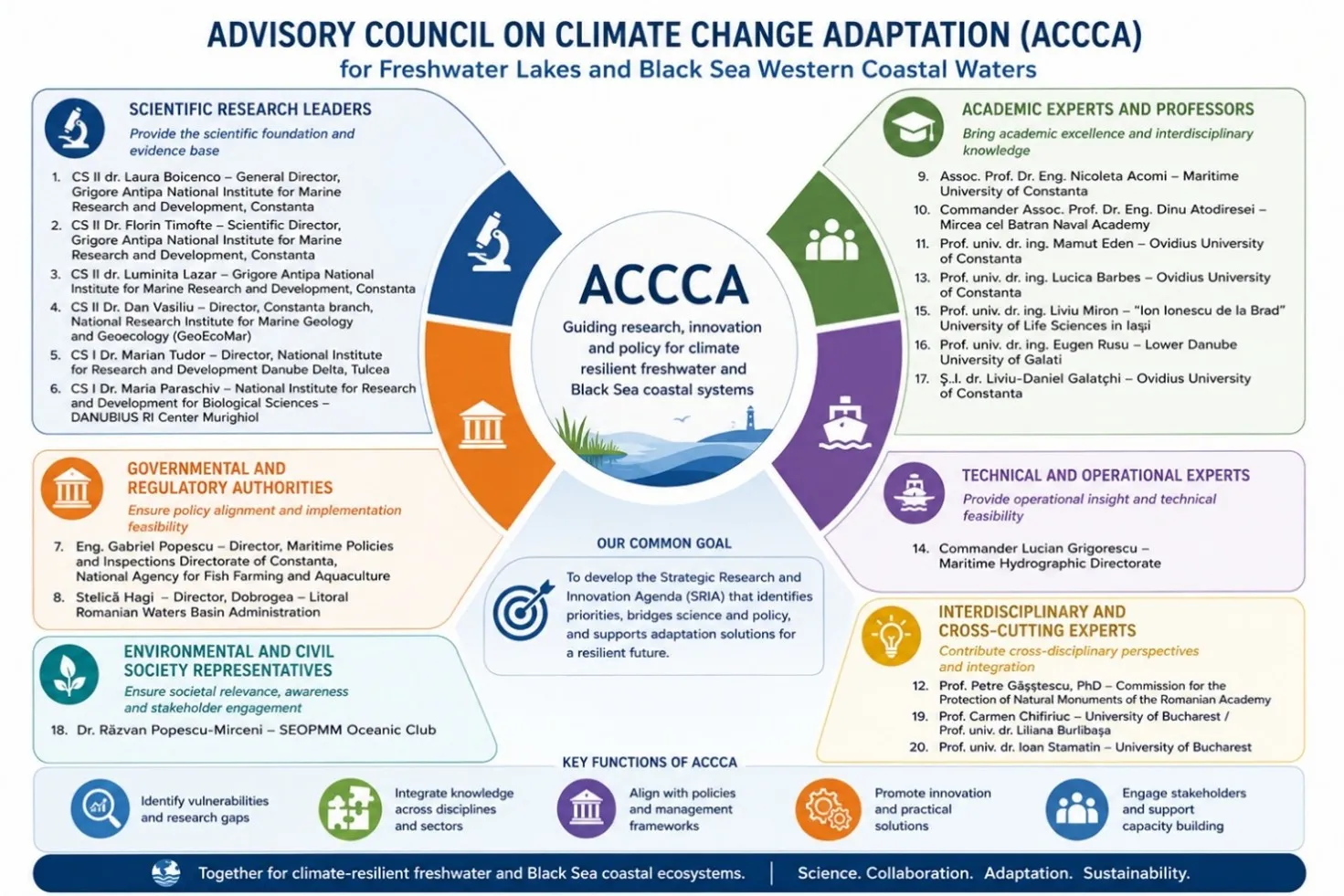
Table of ACCCA sessions:
| No. | Date | Meeting type |
|---|---|---|
| 1. | On 14 December 2023, a hybrid session of the Advisory Council on Climate Change Adaptation (ACCCA) was held in conjunction with the Dobrogea Blue Bay Living Lab, hosted at the Ovidius University of Constanta Campus, Constanța. | hybrid |
| 2. | On 20 March 2024, a hybrid session of the Advisory Council on Climate Change Adaptation (ACCCA) was held in conjunction with the Dobrogea Blue Bay Living Lab, hosted at the Ovidius University of Constanta Campus, Constanța. | hybrid |
| 3. | On 20 March 2025, a hybrid session of the Advisory Council on Climate Change Adaptation (ACCCA) was held in conjunction with the Workshop on Solutions for Increasing the Resilience of Local Communities to Adapt to the Consequences of Climate Change, hosted at the Cultural Centre "Elena Roizen" in Ovidiu, Constanța. | hybrid |
| 4. | On 17 July 2025, a hybrid session of the Advisory Council on Climate Change Adaptation (ACCCA) was held in conjunction with the International Workshop On Blue Economy at the “Remus Opreanu Hall”, Constanta City Council, 51, Tomis Avenue, Constanta, Romania. | hybrid |
| 5. | On 06 April 2026, a hybrid session of the Advisory Council on Climate Change Adaptation (ACCCA) was held in conjunction with the Final conference of the Act4D-Eutrophication project „Digital Twin technologies for climate change adaptation in aquatic ecosystems” at the Google Room, University of Constanta Campus, Constanța. | hybrid |
| 6. | On 07th of April 2026 was organized an online session of the Advisory Council on Climate Change Adaptation (ACCCA). | Online, Webex meeting platform. |